Article 30
Fully Eulerian weak Galerkin methodology with Lagrange multiplier coupling for mixed-dimensional Darcy flow in fractured porous media
A. Laadhari and Mohammed Al Kobaisi, Journal of Computational and Applied Mathematics (Elsevier). In production. Available online November 2026.
Abstract
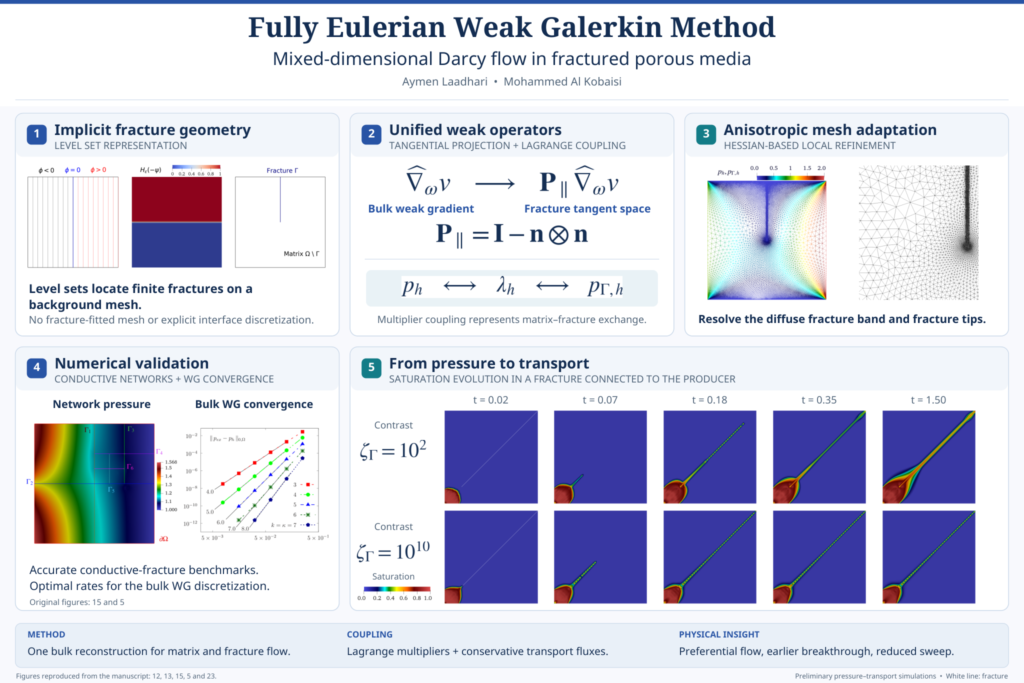
We propose a fully Eulerian weak Galerkin method for mixed-dimensional Darcy flow in fractured porous media. The matrix and lower-dimensional fracture equations are coupled through a Lagrange multiplier formulation, allowing independent discretizations while preserving a consistent representation of matrix–fracture exchange. Fractures are represented implicitly by a level set function, eliminating the need for fracture-fitted meshes. The proposed discretization is based on a discrete bulk weak-gradient operator together with a projected tangential weak-gradient operator constructed through orthogonal projection onto the fracture tangent space. This construction yields a unified operator-based formulation for the matrix and fracture equations, is consistent and coercive on general meshes, and naturally accommodates nonmatching discretizations. The formulation is further combined with Hessian-based mesh adaptation to improve the resolution of immersed fractures. The reconstructed Darcy velocity is subsequently employed in a saturation transport equation, demonstrating the applicability of the proposed framework to coupled pressure–transport simulations.
The numerical results validate the theoretical convergence rates, confirm the accuracy of the proposed formulation for conductive fractures, and demonstrate its ability to capture preferential flow without fracture-fitted meshes.
Highlights
- A fully Eulerian weak Galerkin method avoids fracture-fitted meshes.
- Projected weak gradients unify matrix and fracture discretizations.
- Lagrange multipliers enable locally conservative matrix–fracture coupling.
- Anisotropic mesh adaptation improves the resolution of immersed fractures.
- Pressure–transport simulations capture preferential flow and early breakthrough.