Article 29
Hybrid Weak Galerkin and Physics-Encoded Neural Networks: a sparse local-to-global extension framework for implicit multiphase flow simulation
A. Laadhari, Applied Mathematics and Computation (Elsevier). 533, 130281. Available online 25 August 2026.
DOI: https://doi.org/10.1016/j.amc.2026.130281
https://www.sciencedirect.com/science/article/pii/S0096300326003334
Abstract
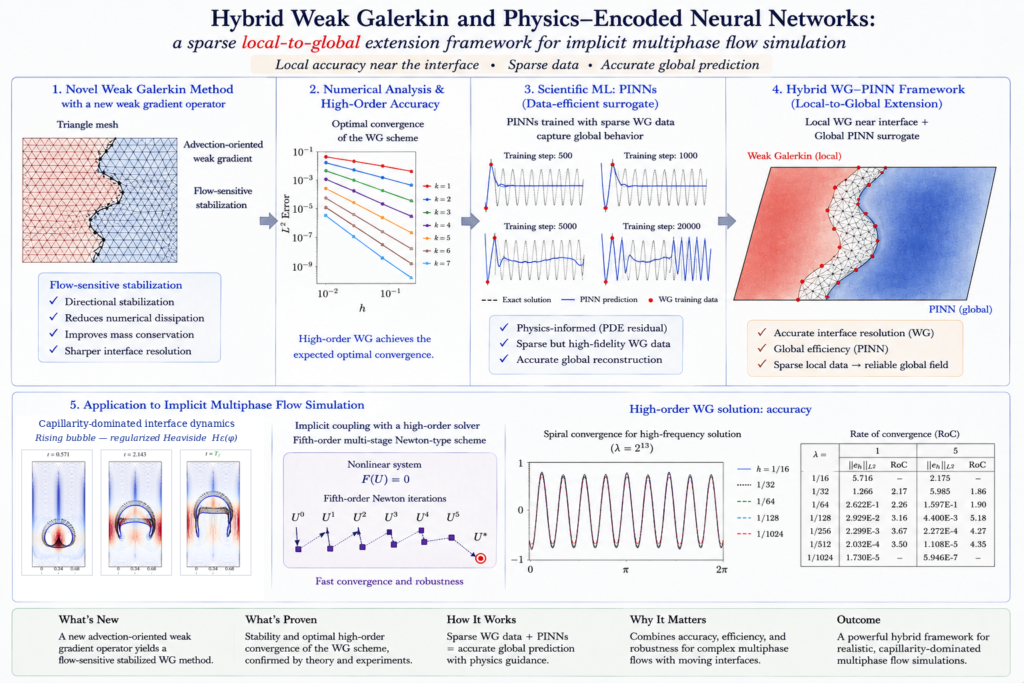
An efficient, conservative hybrid weak Galerkin finite element methodology is proposed to simulate multiphase flows. An advection-oriented weak gradient yields a flow-sensitive stabilized weak Galerkin method. The directional stabilization reduces numerical dissipation, improving mass conservation and preserving interface features. High-order numerical experiments for steady advection confirm the theoretical analysis and exhibit the expected optimal convergence behavior. To achieve a balance between computational efficiency and local accuracy in full-domain settings,
a hybrid strategy resolves advection with high accuracy near the interface.
A Physics-Informed Neural Network (PINN), calibrated with sparse high-fidelity weak Galerkin data from a localized subdomain,
provides a global surrogate of the solution guided by these data, with the weak Galerkin approximation retained near the interface through a blending procedure. The framework extends naturally to time-dependent problems, including level-set transport, and is applied to capillarity-dominated interface dynamics in Newtonian fluids. We also introduce an implicit coupling scheme based on a multidimensional generalization of a fifth-order multi-stage Newton-type scheme. Benchmark tests and numerical comparisons demonstrate the reliability and accuracy of the proposed approach.
Highlights
- Novel advection-oriented weak gradient yields a flow-sensitive stabilized WG method.
- Stability and error analysis prove optimal convergence of high-order WG schemes.
- Scientific ML combines sparse high-fidelity WG data with PINNs for global prediction.
- Hybrid WG–PINN preserves interface accuracy while reconstructing the global field.
- Fifth-order Newton iterations accelerate implicit multiphase flow simulations.